 All resources
What is demand generation? How to pick the strategy that fits your stage
What demand generation is, from a founder who's run it in-house. Pick the strategy for your maturity stage, see what to fix first, and check yours.



The short answer
Demand generation is how a business earns demand from the buyers it wants. It attracts the right people, qualifies their interest, and converts that interest into sales pipeline and revenue. It runs as one plan across your channels, so marketing and sales work toward the same buyers and the same numbers.
Notice the word "earns." Most guides say demand gets created, then captured, and skip everything in between. In my years running demand gen in-house, that middle is where you nurture interest and earn trust.
This guide shows you which strategy fits your company today and what to fix first. You'll also see what I changed when I took over a team that ran lead gen and called it demand gen.
It's written for business-to-business (B2B) software and tech marketing leaders. Want a quick read on your stage first? The free Demand Generation Maturity Assessment (DGMA) takes about four minutes.
Demand generation vs. lead generation
Lead generation turns interest into contacts that sales can follow up with. Demand generation is the whole system around it: reaching future buyers, qualifying interest, and converting it into pipeline. Lead gen is one job inside it.
The difference matters because most of your future buyers aren't shopping yet. Professor John Dawes's 95-5 rule comes from the LinkedIn B2B Institute. It estimates that up to 95% of B2B buyers aren't in the market in a given quarter. He calls it a rule of thumb.
Your real share depends on how often your category gets bought. In Dawes's own example, if buyers replace a product every two years, about 13% are in the market each quarter. Either way, a plan that only counts people ready to talk today misses most of your market.
| Lead generation | Demand generation | |
|---|---|---|
| Goal | Contacts sales can follow up with | Qualified pipeline and revenue |
| Who it reaches | Mostly people willing to share details now | Your ideal buyers, before and while they shop |
| What often gets counted | Leads and cost per lead | Opportunities, pipeline, and revenue by channel |
| Who owns it | Often marketing | Marketing and sales, with one shared lead definition |
How you earn demand: attract, qualify, and convert
Sharelitix runs demand generation as three steps: attract, qualify, and convert. Together, they're how you earn demand. Buyers can move back and forth between the steps, and qualifying keeps going during sales.
| Buyer's funnel stage | Your step | What the work looks like |
|---|---|---|
| Awareness | Attract | Posts, search, ads, and site visits that earn the right buyers' attention |
| Interest | Qualify | Downloads, webinars, nurture emails, lead scoring, and handoff rules |
| Consideration | Convert | A first sales conversation, such as a strategy call |
| Decision | Convert | The proposal, the first paid project, and the signed deal |
Qualify is where most plans get thin. It's the messy middle that "create and capture" skips. This step sorts interest by fit, timing, and intent, then helps it grow until the buyer trusts you enough to talk. Do it well, and by the time they're ready to buy, you're the obvious choice.
Scoring and grading answer two different questions. The Share Pro Blueprint puts it this way: "Activity says they're interested. Fit says they're worth the call. Sales gets both."
So a clear poor fit comes out of the sales path, however active it is. A good-fit buyer who isn't ready yet goes to nurture. A strong-fit account with little activity is worth a closer look, and sales and marketing decide together whether to reach out.
What it looks like when lead gen passes for demand gen
Plenty of teams call their work demand gen when it's lead gen with a new name. Some don't know the difference. Others know it but get judged on lead counts, so lead counts are what they chase. Watch for these signs:
- The main report is leads and cost per lead
- Sales says the leads are bad, and marketing says sales doesn't follow up
- The plan is a calendar of campaigns with no pipeline goal attached
- Nobody can say which channel produced last quarter's pipeline
A real example: turning a lead gen team into a demand gen team
Before I founded Sharelitix, I led demand gen at a B2B fleet software company. On paper, the team ran demand gen. In practice, it was focused on lead volume.
Here's what I found:
- Anyone who filled in a form counted as a marketing qualified lead (MQL) and went straight to sales. There was no lead scoring or grading
- Some contacts came from purchased lists
- Agency work wasn't delivering the results we expected
- The ad budget was big, but tracking stopped partway down the funnel. The tracking tags on links (UTMs) weren't set up the same way, so attribution didn't work
- The only goal was an MQL number, and it wasn't based on past results
Conversion rates were low, and pipeline couldn't be traced back to marketing. The focus was on getting leads in, not on turning them into deals.
My first 30 days, in order
First, measurement. I went through the customer relationship management (CRM) system, the marketing automation platform, and every channel. I also reviewed the deals we'd won and lost to see which segments bought.
Second, qualification. There were no criteria at all. So I built a new lead scoring and grading model. Leads went to nurture first, and reached sales once they knew more about us.
Third, channels. The ads chased leads everywhere, even in retargeting, with no plan for each stage of the funnel. I set out to fix that with a full-funnel structure.
The three things I changed
- A plan that worked back from revenue. I started with the revenue goal. Then I worked back to qualified opportunities, meetings booked, leads, and finally the clicks each channel needed
- Tracking that connected. We set one standard for UTMs and connected the CRM, marketing automation, and every channel. That improved our view of the journey from marketing activity to closed deals
- Integrated campaigns. Instead of one-off activities, we ran campaigns under one umbrella, aimed at the best-fit segments from the won and lost review
What happened after
Leadership started watching conversion rates, lead quality, and pipeline more closely. That wasn't happening before. Sales was happier with the leads than ever, and we could forecast our results. From then until I left, we never missed a quarterly pipeline goal.
My approach was to measure first, then qualify, then tune the channels.
When you're not ready for demand generation yet
Demand gen isn't the right first move for every company. In my view, it's too soon if:
- You don't have product-market fit yet
- Sales is mostly founder-led, with no brand or clear positioning that sets you apart
- You can't name your market, so you're targeting everyone
You don't need to know everything about your ideal customer profile (ICP). You do need a rough idea of who it is. Until then, run small tests to learn, but don't call it demand gen. It's random acts of marketing: throwing darts and hoping one sticks.
Which demand generation strategy fits your stage
Most strategy guides give everyone the same tactics: content, email, ads, events, and account-based marketing (ABM). But a team with broken tracking needs a very different next step than a team with a tuned system.
The Share Pro Blueprint sorts demand gen systems into four maturity stages: Reactive, Foundational, Established, and Share Pro. Its rule for the order of work is short: "If tracking has gaps, the numbers can mislead. So measurement goes in first. Then qualification, then channels."
Think of it like building a house. You pour the foundation, then frame the walls, then pick the paint. Pick the paint first, and you'll be painting twice. While you fix tracking, keep reaching future buyers, and size new spend to what you can measure.
| Your stage | Focus first | Go slow on | Number to watch |
|---|---|---|---|
| Reactive | One written plan and basic tracking | Big new platform or channel commitments | Source coverage |
| Foundational | One lead definition, scoring, and nurture | Big spend increases you can't check yet | Accepted lead to opportunity rate |
| Established | Tuning and testing the channels you run | New channels before current ones are understood | Pipeline by channel |
| Share Pro | Expanding where results support it | A rebuild you don't need | Pipeline per dollar |
Reactive: get one plan on paper
The Blueprint's description: "There's no written strategy, and campaigns are one-offs. Attribution is broken, and the tools don't talk to each other." The SaaS company from my story started here, with no goals based on past results, no clear tracking, and no qualifying rules.
Your strategy here is focus. Write down who you sell to, one pipeline goal, and the few actions that count, like a demo request. Track each of those with its source. Go slow on new platforms and ABM tools, and don't scale spend on numbers you can't trust yet.
Foundational: make the numbers trustworthy
The Blueprint's description: "A basic strategy and repeatable campaigns, with some attribution. Tools are connected, and Sales gets a working handoff."
Your strategy here is a tighter handoff. Agree with sales on one written lead definition. Add lead scoring and grading, then build nurture for leads that aren't ready yet. Go slow on big spend increases until you can see what they produce.
How to get sales to agree on one lead definition
Sit down together and agree you're on the same side. Be open about what the scoring and grading rules count. Then ask sales, "From your experience, what kind of lead is easy to win?" Their answer goes into the rules.
Agree up front that it won't be perfect the first time, and may never be, because your market keeps moving. Put a review date on the calendar.
Once it's live, watch for two traps:
- The big account grabbed too early. At the SaaS company from my story, these were large, enterprise-level accounts. A rep would reach out before the lead hit the agreed score, then learn it wasn't ready to buy
- The hot lead left to cool. A lead hits the score, but nobody calls for a month or two. By then the buyer can't remember why they reached out
The rule I'd set catches both. Have sales wait until a lead hits the score you both agreed on, then follow up soon after.
Established: get more from what you run
The Blueprint's description: "A clear strategy, coordinated channels, consistent lead handoffs, and reporting that supports pipeline planning."
Your strategy here is tuning. Test offers, messages, and audiences inside the channels you already run. Go slow on new channels until you know what the current ones produce.
Share Pro: test, then expand
The Blueprint's description: "Marketing runs as a revenue function. Testing never stops, and decisions come from data."
Your strategy here is careful growth. Expand where results support it, such as an ABM pilot for your best-fit accounts. Don't rebuild what works, or cut it to chase a short-term lead target.
A note on channels
At every stage, start with the channels your buyers already use, and plan them as one system.
Two I'd be careful with right now are organic LinkedIn and podcasts. LinkedIn feeds are more crowded than they used to be, and not every niche is active there. Check that your buyers post and comment there before you bet on it. Podcasts take a lot of work, and many never get the reach their makers hoped for.
One I think is underrated is content syndication: paying a vendor to put your content in front of a set audience. Pick a vendor that lets you target by job title, company size, and your own custom rules. Done that way, you can run it as ABM or as a wider demand gen play.
Demand generation content: what to use at each step
Content does a different job at each step. Some pieces earn attention, some help a buyer raise their hand, and some help them say yes. Here are 13 common types and the step each one helps most. Pick by the gap you're fixing, not by what's quickest to make.
| Content type | What it is | Example | Step it helps most |
|---|---|---|---|
| Free tools | A calculator or planner buyers use for free | A return on investment (ROI) calculator | Attract, qualify |
| Ebooks | A long guide on one topic | A guide to fixing the marketing-to-sales handoff | Attract, qualify |
| Webinars | A live online class with questions at the end | A session on building a lead scoring model | Qualify |
| Templates | A ready-made plan or checklist buyers fill in | A one-page demand gen plan template | Attract |
| Infographics | A picture that makes data easy to scan and share | The funnel graphic in this guide | Attract |
| Product demos | A walkthrough of your product doing a real task | A short video of your software at work | Convert |
| Survey reports | Findings from your own survey of buyers | A yearly report on how buyers plan budgets | Attract |
| Interactive tools | Quizzes or assessments that give each buyer a result | The free DGMA, which gives you a stage | Qualify |
| Free trials | Time to use the product before paying | A 14-day free trial | Convert |
| Website pages | Pages that inform visitors and ask them to act | A landing page offering a free consultation | Qualify, convert |
| Blog | Regular posts that answer buyers' questions in search | A weekly post on a problem buyers search for | Attract |
| Public relations (PR) | Media coverage from press releases or pitches | An award announcement that trade sites cover | Attract |
| Case studies | What changed after a real customer used your product | Their before and after, in numbers they approved | Convert |
Demand generation channels
No single channel reaches every buyer, so plan a few that work together. Here's a broad list of demand generation channels and tactics to pick from. You don't need all 26. Choose the ones your ideal customer profile (ICP) already uses.
A few entries are tactics, not channels. CRO improves the pages buyers land on, and programmatic is a way to buy ads. If buyers visit your demo page but few book, test the page before you buy more traffic.
- Affiliate marketing: Partners promote you to their audience and earn a commission for each sale or qualified lead. Examples: Affiliate programs, referral partnerships, influencer affiliate networks
- Associations: You partner with groups your buyers belong to, so you borrow their trust and reach. Examples: Trade associations, industry groups, professional bodies
- Communities: You take part in the groups where your buyers already swap advice, and earn their trust over time. Examples: Online forums, branded groups, social media communities
- Connected TV (CTV): Ads that play on smart TVs and streaming devices while people watch shows. Examples: Roku, Amazon Fire TV, Hulu
- Content syndication: A third party puts your content in front of its audience, free or paid. Outbrain and Taboola promote links to your content, and Medium can host a republished article. Examples: Outbrain, Taboola, Medium
- Conversational marketing: You talk with buyers in real time, on your site or in messaging apps. Examples: Live chat, chatbots, messaging apps
- Conversion rate optimization (CRO): You improve your pages so a bigger share of visitors take the next step, like a demo request. Examples: A/B testing landing pages, optimizing call-to-action (CTA) buttons, simplifying the user journey
- Direct mail: Physical mail sent straight to the people you want to reach. Examples: Postcards, catalogs, promotional brochures
- Display advertising: Image and video ads on websites and apps that put your brand in front of new or returning buyers. Examples: Google Display Network, native ads, banner ads
- Email marketing: Targeted emails that nurture leads and keep customers engaged. Examples: Newsletters, promotional emails, drip campaigns
- Events: Events you host or sponsor online, in person, or both, so you can talk with buyers directly. Examples: Webinars, conferences, product demos
- Influencer marketing: You work with people your buyers already follow, so they share your message with their audience. Examples: YouTube sponsorships, Instagram influencer posts, TikTok creator partnerships
- Native advertising: Paid ads made to match the look of the page they sit on. Examples: Outbrain, Taboola, Yahoo Native Stream ads (powered by Taboola)
- Paid social advertising: Paid ads on social networks, aimed at an audience you choose. Examples: LinkedIn Ads, Facebook Ads, Instagram Ads
- Paid search: These ads appear in search results and often use pay-per-click (PPC) pricing. They reach people who are already searching. Examples: Google Ads, Microsoft Advertising (formerly Bing Ads), Amazon Ads
- Partnership marketing: You team up with another company to reach its audience. Examples: Co-branded content, affiliate marketing, joint webinars
- PR (public relations): You earn media coverage and shape how your market sees you. Sponsored articles are paid placements, not earned coverage. Examples: Press releases, media interviews, sponsored articles
- SEO (search engine optimization): You make your site and content easier to find in search results, so you get visits without paying per click. Examples: Google, Bing, Yahoo
- Social media marketing: You build an audience and relationships on social networks with unpaid posts, often called organic social. Examples: LinkedIn, Facebook, X (formerly Twitter)
- Offsite channels: You publish content on other sites to get seen and build authority. Examples: Guest blogs, press articles, industry publications
- Podcasts: Audio shows that teach your audience or tell stories from your field. Examples: Interviews, industry updates, brand storytelling
- Programmatic advertising: A way to buy ads. Software buys ad space for you, either at a set price or through an auction, aimed at the audience you pick. Examples: Google DV360, Amazon DSP, The Trade Desk
- Review sites: Sites where customers rate products. New buyers check them before they buy. Examples: G2, Trustpilot, Yelp
- SMS marketing: Text messages sent to people who agreed to get them. Keep promotional texts and service texts apart, because agreeing to order updates isn't agreeing to promotions. Examples: Promotional offers, event reminders, order updates
- Video marketing: Videos that teach, entertain, or persuade your buyers. Examples: YouTube, Vimeo, TikTok
- Webinars: Online classes, live or on demand, that teach buyers and show what you know. Examples: Industry insights, product demonstrations, Q&A sessions
Demand generation tools and software
Your marketing technology (MarTech) stack runs and measures everything above. Start with a CRM, marketing automation, and analytics. Get those three talking to each other before you add the rest. Here are the nine main types, with examples.
- Marketing automation platforms: Score leads and send follow-up emails based on what buyers do, so you can personalize without doing it all by hand. Examples: Adobe Marketo Engage (formerly Marketo), HubSpot Marketing Hub, ActiveCampaign
- Customer relationship management (CRM) software: Keeps contacts, deals, and logged conversations in one place, so Sales and Marketing see the same record. Examples: Salesforce, HubSpot CRM, Zoho CRM
- Analytics and data visualization software: Shows how marketing performs, using data from your site, campaigns, or sales records. Examples: Google Analytics, Adobe Analytics, Domo
- Advertising technology (ad tech): Where you buy ads, pick audiences, set budgets, and track spend across channels. Examples: Google Ads, Meta Ads Manager (formerly Facebook Ads Manager)
- Content management system (CMS): Where you build, edit, and manage your website's pages and posts. Examples: WordPress, Adobe Experience Manager, Wix
- Social media management tools: Schedule and publish posts, then track engagement across your social accounts. Examples: Hootsuite, Buffer, Sprout Social
- Customer data platforms (CDP): Pull customer data from many sources into one profile per person, so you can group and personalize. Examples: Twilio Segment, Tealium, BlueConic
- Chatbot and conversational marketing tools: Let you chat with site visitors, with a bot or a teammate, and spot leads worth a sales call. Examples: 1mind (Salesloft's chat partner, formerly Drift), Intercom, Tidio
- Project management software: Keeps campaign tasks, owners, and deadlines in one place, so campaigns ship on time. Examples: Asana, Trello, Monday.com
Find your gaps: a five-question self-check
Answer yes or no. Be strict with yourself: "sort of" counts as no.
| Question | If the answer is no, look at |
|---|---|
| 1. Do you have a written demand gen strategy that sales has seen? | Writing one plan with sales |
| 2. Can you show which channels your records credit for last quarter's pipeline? | Source tracking and rules |
| 3. Do marketing and sales use one written definition of a qualified lead? | The lead definition and handoff |
| 4. Do your channels run from one shared plan? | Planning channels together |
| 5. Do you change the plan each quarter based on pipeline results? | A regular review rhythm |
Each "no" points to a gap, not your stage. For a fuller read, take the free DGMA. It asks 20 questions across strategy, tactics, process, and marketing technology (MarTech). You get a score, an estimated stage, and next steps.
How to measure demand generation
Track a few numbers at every stage, not just the leads at the top. This graphic shows each funnel stage with its goal, the team that usually leads it, and the key metrics.
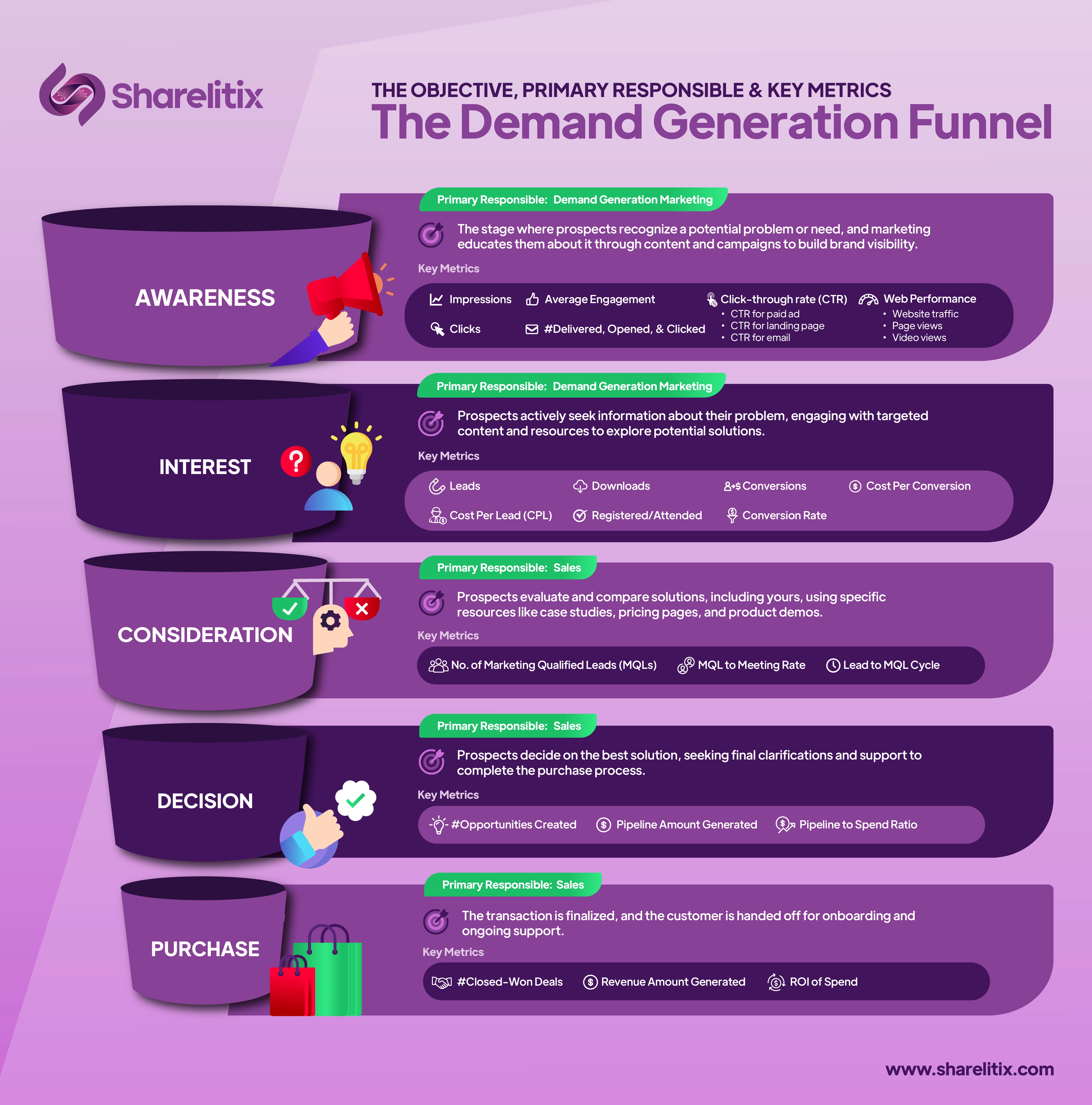
Five funnel stages, each with what buyers do, who usually leads, and what to measure. The signed deal gets its own Purchase stage.
The table below turns that graphic into a list you can copy. It maps each stage to your step: attract, qualify, or convert. The signed deal sits under Decision, as it does earlier in this guide. The last column shows how to count the main number at each stage.
A number only helps if everyone counts it the same way. Write down your time windows and keep them the same each quarter.
| Stage (your step) | What to track | What it tells you | How to count the main number |
|---|---|---|---|
| Awareness (attract) | Visits and replies from people who fit your ICP. Also impressions, reach, clicks, and click-through rate on ads, emails, and landing pages. Plus page views, video views, engagement, shares, new followers, and brand mentions. | Whether the right buyers notice you. | ICP visits: visits from people at companies that fit your ICP. Count each month. |
| Interest (qualify) | Leads that fit your ICP, and leads sales accepts. Also downloads, webinar sign-ups and attendance, newsletter sign-ups, conversion rate, and cost per lead. Plus leads that reach your agreed score and grade (often called MQLs), and how long that takes. | Whether interest is turning into buying signals. | Source coverage: new leads with a source set under your rules, divided by all new leads. Count each month. Sales acceptance rate: leads sales accepts, divided by leads marketing passes to sales. Count each month. |
| Consideration (convert) | Demo and trial requests, meetings booked and held, and sales qualified leads (SQLs). Also the rate from scored lead to meeting booked. | Whether qualified interest reaches a real sales conversation. | Accepted lead to opportunity rate: of accepted leads, the share that became opportunities. Count one month's leads, over one sales cycle. |
| Decision (convert): pipeline | Opportunities created, pipeline, and qualified pipeline. Also pipeline by channel, average deal size, and pipeline per dollar. | Whether the work builds pipeline you can forecast. | Pipeline by channel: value of new opportunities, grouped by the channel your attribution rule credits. Count each quarter. Pipeline per dollar: attributed new pipeline, divided by the spend tied to it. Use the same quarter, or spend to new opportunity. |
| Decision (convert): signed deal | Closed-won deals, win rate, and revenue by channel. Also return on ad spend (ROAS), customer acquisition cost (CAC), and customer lifetime value (CLV). | Whether the work turns into revenue at a cost that makes sense. | Revenue by channel: closed-won revenue, credited with the same rule as pipeline. Count each quarter. |
Don't over-read two of the numbers above. High source coverage means sources got filled in, not that tracking caught every touch. Pipeline by channel shows where your rule gives credit, not necessarily what caused the deal.
The most over-read number in B2B marketing
It's the MQL count. Plenty of advice says not to judge marketing on MQLs alone. Many teams still look at nothing else. An MQL count can climb every month while pipeline stays flat. The SaaS company from my story had an MQL goal and no way to trace the pipeline behind it.
What I'd show a CEO each month
Three numbers: pipeline, pipeline per dollar, and return on ad spend (ROAS). Pipeline matters most. The other two show whether you're getting it at a sensible cost.
Ask "How did you hear about us?"
Add the question to your forms. In my experience, it catches what click tracking misses, like podcasts, third-party ads, and connected TV. Treat the answers as clues, not exact counts.
How long before demand gen shows up in pipeline
It depends on your sales cycle and how fast you launch. Putting a new plan in place can take one to two months on its own. Here's what I'd expect once a plan goes live:
| Your sales cycle | When early pipeline usually shows up |
|---|---|
| About three months | Around the second month |
| About six months | Around the third or fourth month |
Longer cycles need more nurture and retargeting before buyers talk to sales. Results sometimes show up in the first month when everything goes right. Don't build your plan on that.
From a focus to a quarterly strategy
A focus tells you what to fix. A quarterly strategy also names the buyers, the goal, the channels, the owner, the budget, and the review date. This example is made up. Every number is an assumption to show the math, not a benchmark or a client result.
| Part of the plan | Example |
|---|---|
| Company | A B2B software company selling compliance software to mid-size US manufacturers |
| Assumptions | Average deal $30,000. About 40% of accepted leads become opportunities within a month. Sales cycle about four months |
| Pipeline goal | $900,000 in new qualified pipeline this quarter: 30 opportunities at $30,000 each |
| What that takes | About 75 sales-accepted leads in the first two months, because 75 × 40% = 30 |
| Channels | LinkedIn ads, paid search, content syndication, and a monthly webinar with nurture emails |
| Budget | $45,000 a month: LinkedIn $17,000, search $10,000, content and syndication $9,000, tools $6,000, webinar $3,000 |
| Owners | The demand gen lead owns the plan. A sales manager owns follow-up |
| Review dates | Monthly check on accepted leads and source coverage. Full review in the quarter's last week |
The quarter's spend is $135,000, so the goal is about $6.70 of pipeline per dollar. With a four-month cycle, much of the revenue may close next quarter, so the review judges pipeline.
A few things I'd watch in any split like this. Webinars shouldn't cost much: about $5,000 a month at most, unless you're paying to promote them. For this example, I'd allow more than $5,000 a month for tools. LinkedIn ads usually get the biggest share, as they do here.
Then stick to the plan
The biggest mistake I see marketing leaders make with demand gen strategy? They don't follow it.
The year starts with a good plan. Then the pressure builds, and leaders start to freestyle. They take on side requests from sales and other teams, and the core work slips. The team under them feels it most, and results sometimes go backward.
If the plan is good and early results match it, stick with it. Review it on the dates you set, and adjust sooner if the evidence calls for it.
Where to start
Pick the gap from your self-check. Write the one-page plan around it. Then review it on the date you set. Not sure which stage you're in? The free DGMA gives you a rough stage in about four minutes.
Want a second opinion on your stage? Book a Strategy Call. We'll go over your goals and pipeline, find your biggest leaks, and tell you honestly whether Sharelitix is the right fit.
Thinking about outside help? Start with the 8 signs it's time to hire a demand generation agency. Then read how to choose the right B2B demand generation agency.
Questions people ask
What is the difference between demand generation and lead generation?
Lead generation turns interest into contacts that sales can follow up with. Demand generation is the full system. It attracts the right buyers, qualifies their interest, and converts it into pipeline and revenue. Lead gen is one part of demand gen.
What is a demand generation strategy?
A demand generation strategy is a written plan for how you'll attract, qualify, and convert your ideal buyers. It names who you sell to, your pipeline goal, your channels, the owner, the budget, and the review date. It starts from your biggest gap.
What are the stages of the demand generation funnel?
Awareness, Interest, Consideration, and Decision. In Awareness, you attract the right buyers. In Interest, you qualify them with nurture, scoring, and grading. In Consideration and Decision, you convert them into opportunities and revenue.
How do you measure demand generation?
Track each step. For attract, track visits and replies from people who fit your ideal customer profile. For qualify, track the leads sales accepts. For convert, track opportunities, pipeline, win rate, and revenue by channel.
How long does demand generation take to show results?
It depends on your sales cycle and how fast you launch. With a three-month sales cycle, early pipeline often shows up around the second month after launch. With a six-month cycle, expect it around the third or fourth month.
When is a company not ready for demand generation?
When it has no product-market fit, relies on founder-led sales with no clear positioning, or can't name its market. Small tests help you learn at that point. A full demand generation program comes after.
Which demand generation strategy should a B2B SaaS company start with?
Start with your biggest gap. Without a written plan or basic tracking, start there. With those in place, set one lead definition, scoring, and nurture. Teams past that should tune their channels, then test and expand.
About the author
Motaz Gandol is the founder of Sharelitix. He has nearly 10 years of experience in demand generation and B2B marketing. Before Sharelitix, he led demand generation in-house at B2B software and technology companies.