
 All resources
How to choose the right B2B demand generation agency
Compare agency scope, proof, reporting, and account access. Match the partner to your maturity stage so you choose a team that fits your goals.



The short answer
Choose a demand generation agency by checking how it connects your growth goals to a clear plan, named work, and results you can verify. Ask who owns your accounts and data, how leads become sales opportunities, and what your team must do. Compare proposals on scope and evidence, not lead counts or confident promises.
This guide is for business-to-business (B2B) software and tech leaders who've already decided they need outside help. Still deciding? Start with whether you need an agency at all.
Want a second opinion while you compare? Book a Demand Generation Strategy Call.
Step 1: Write your own buying brief first
Most teams start by comparing agencies. Start by writing one page about yourself instead. It keeps every pitch pointed at your problem, and it makes proposals easy to compare.
Put these on the page:
- Your goal, if you have one: the pipeline or revenue number you're trying to reach
- Your starting numbers: where pipeline, opportunities, and spend sit today
- Your buyers: the roles in a typical buying group
- Your owner: the person on your side who'll run the relationship
- Your gaps: strategy, execution, process, or data
- Your budget limits: fees and ad spend, even as a rough range
Send the same page to every agency. If a pitch ignores it, you've learned something.
Step 2: Match the partner to your stage
Every guide says to find an agency that "fits." Few say what fit means. Here's a practical way to define it: match the kind of help to how built your demand gen system already is.
Sharelitix uses four maturity stages. The descriptions below come from the Share Pro Blueprint. Find the row that sounds most like your team today.
| Your stage | What it looks like | Buy this first |
|---|---|---|
| Reactive | No written strategy; one-off campaigns; broken attribution | A diagnosis and a written plan |
| Foundational | A basic strategy, repeatable campaigns, some attribution | Tracking you trust, then one connected plan |
| Established | Clear strategy, coordinated channels, steady handoffs | Help running and testing more channels |
| Share Pro | Marketing runs as a revenue function; testing never stops | Specialist depth where you need it |
Then use your row to spot a bad fit. Here's what to go slow on at each stage, and what a good agency tends to say.
| Your stage | Go slow on | A good agency answer sounds like |
|---|---|---|
| Reactive | Big commitments with no plan to judge them | "Let's write the plan and set up basic tracking first" |
| Foundational | Big spend with no goal or check | "Here's the goal for this spend, and how we'll check it" |
| Established | New channels before you know what the current ones produce | "Let's get more from what you already run" |
| Share Pro | A full rebuild you don't need | "Here's the one area we'd test next" |
None of these is a ban. Brand work, for example, can make sense at any stage. Most of your future buyers aren't shopping yet. John Dawes's 95-5 rule puts that share as high as 95% in a given quarter, depending on how often your category gets bought. Those buyers need to know you before they shop. The rule is to match the size of a commitment to the evidence behind it. A small test needs a clear goal. A big contract needs proof that it fits your stage.
Not sure which row is yours? The free Demand Generation Maturity Assessment (DGMA) gives you a rough stage in about four minutes. It's a self-check, not a full diagnosis, but it's a good starting point for this table.
Then judge each proposal against your stage, not against the pitch. A Reactive team doesn't need a slick plan for six channels. An Established team doesn't need a starter kit.
Step 3: Decide between strategy, execution, or both
Agencies sell different kinds of help under the same label. Know which one you're buying before you compare prices.
| Strategy-only | Execution-only | |
|---|---|---|
| What it is | A consultant who gives direction at a high level | A specialist who takes work off your team's plate |
| What you get | A clear strategy your team works from | Your strategy turned into the right activities, done well |
| Who does the work | Your team | The agency |
| Best when | Your team can execute but lacks a clear plan | You have clear objectives but not enough hands |
If you need both, look for one partner that plans and runs the work together, so nothing gets lost in the handoff. Sharelitix services come in these two halves, and you can take one or both.
Then compare proposals like for like. Line up the same items for each:
- Work included, and work left out
- Agency fees
- Ad spend, kept separate from fees
- Tools you'll need to pay for
- Setup costs, if any
- Contract length and notice period
- Hours your own team will spend on the work
Step 4: Tell a good plan from a polished pitch
Every agency has a good deck. What you're buying is the plan behind it.
When I review a plan, I look for four things. Clear timelines. Clear objectives that match what you're trying to achieve. Clear activities. And a named owner for each task, with what that owner is expected to deliver.
Turn those into questions for every agency you meet:
- "What are the timelines for the first piece of work?"
- "Which of our objectives does each part of the plan serve?"
- "What activities will happen each month?"
- "Who owns each task, and what do they deliver?"
A strong agency answers with names, dates, and outputs. A weak one answers with adjectives.
Want to test your shortlist against these questions? Book a Demand Generation Strategy Call.
Step 5: Run seven checks on every agency
Use these seven checks on each finalist. Each has a question to ask, the evidence to request, and a red flag.
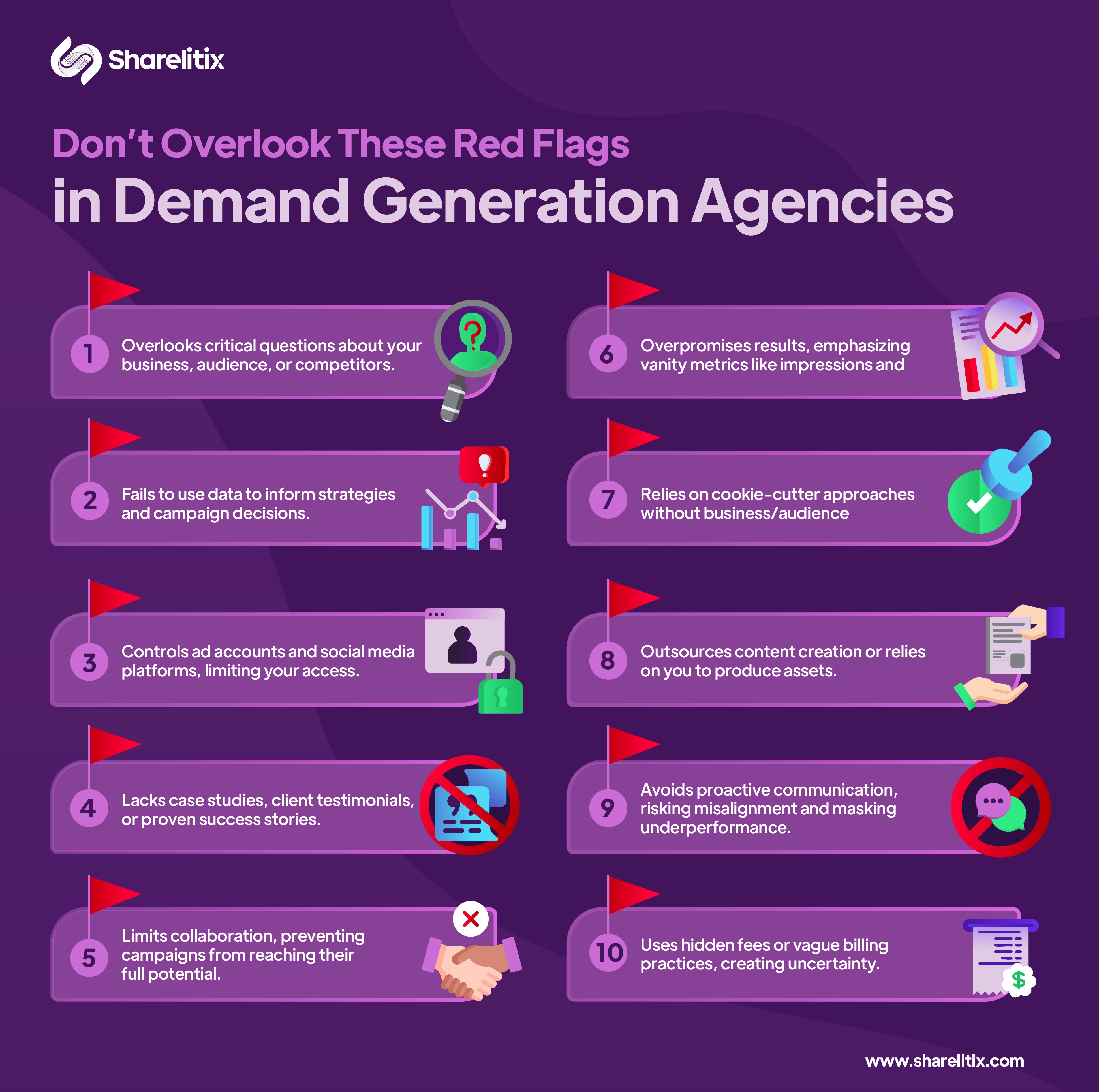
1. Fit with how your buyers buy
Ask: "Where have you worked with a buying process like ours?"
Request: One or two examples with a similar buying motion, such as B2B sales to buying groups with long cycles. Then ask how they'd apply that work to your buyers.
Red flag: They can't explain how their past work carries over to your buyers.
2. Diagnosis before tactics
Ask: "What would you look at before you recommend channels?"
Request: The steps they take in the first weeks.
Red flag: A channel plan in the first meeting, before they've seen your data.
3. Connected channels
Ask: "How do our channels work together in your plan?"
Request: An example where one channel's results changed another channel's plan.
Red flag: Each channel has its own report, and nobody owns the whole picture.
4. Lead rules and the sales handoff
Ask: "How does a lead become a sales opportunity, and who decides?"
Request: A sample report that traces spend to opportunities, with its limits explained.
Red flag: Success is measured in leads, clicks, or impressions only.
5. The people doing the work
Ask: "Who will do the work, and who's accountable for the results?"
Request: The names and roles of the people who'll do the work, beyond the ones in the pitch. Ask who checks the work, and who you'll talk to each week.
Red flag: The senior people disappear after the contract is signed.
6. Account ownership and access
Ask: "Who will own the ad, analytics, and tracking accounts you run for us? Who gets which permissions?"
Request: A written list of each account, whose name it's under, and who holds admin rights.
Red flag: Accounts set up under the agency's name, or you can see reports but not the accounts behind them.
At Sharelitix, you have access to every account we run for you, such as the paid search and paid social accounts. You can see what's being done.
7. Exit terms in writing
Ask: "If we stop working together, what do we keep, and how does the handoff work?"
Request: Clear, written terms that cover your accounts, your data, creative files, the tracking setup, the contract length, and the notice period.
Red flag: Vague answers, or "we'll sort that out later."
Whoever you pick, get the ownership and exit answers into the contract, not just the pitch.
The promise that should make you pause
The promise that makes me pause is any guaranteed number. "We guarantee $X in pipeline." "We guarantee $X in revenue."
Pipeline depends on your data, your buyers, and your sales follow-up. No agency controls all three.
When you hear a guarantee, ask a different question: "How would you measure progress in the first few months instead?" A good partner has a clear answer. It'll be about the steps that lead to pipeline, and how each one gets tracked.
Step 6: Test the case study behind the result
A big number on a case study tells you something happened. It doesn't tell you what the agency did or whether it'd work for you. Ask four things about every case study:
- What was the starting point?
- What exactly did the agency do?
- What was the result, and how was it measured?
- How does it apply to your buyers?
Here's how we'd answer all four for one of our own clients.
When we started with AbTech, an environmental technology company, it was in a spot most growing teams know well. There wasn't much history yet to show what had worked and what hadn't. Its customer relationship management (CRM) system and marketing automation platform had room to connect better. And its marketing activity needed a clear way to measure what was working.
To measure change, we first chose the right key performance indicators (KPIs) for each funnel stage and each phase of the buyer journey. Then we put tracking in place: checkpoints for each phase, so the team always knew where it stood. With little history to learn from, we ran enough tests across different activities to learn what moved their ideal customer profile (ICP). Once those KPIs gave us real benchmarks, we set goals from them.
The result: the AbTech case study reports +213% sales-qualified opportunities and +187% marketing-attributed revenue, both year over year. Those results came from the whole system working together: strategy, content, paid channels, lead qualification, and tracking.
How it applies to you: AbTech's buying groups ran from 4 to 10+ people, and its sales cycles took six months or more. If your deals look like that, this is the kind of buying the work was built for. If they don't, ask any agency, us included, how they'd adapt it.
Step 7: Agree on the first piece of work
Before you sign, agree on how the work starts. Write down:
- Deliverables: what the first piece of work produces, and by when. For example, a written plan, a tracking review, or the first campaigns
- Scope: what's in, and what isn't
- Baseline: the numbers you'll measure change against
- Review dates: an early check on signals like tracking and lead quality, then later reviews for pipeline
- Pipeline timing: set from your own sales cycle. If deals usually take six months, a first-quarter revenue verdict may be too early for newly created opportunities. Some may close sooner. Agree which early signals you'll judge instead
- Costs: fees, ad spend, tools, and setup, each on its own line
- Contract length and notice period
- Access and owner: which systems the agency needs, who grants it, and who runs the relationship on your side
If an agency resists any of these, that's your answer.
Make the call
Use a two-step rule so every finalist gets judged the same way.
- Close the gaps first. Each finalist must give clear written answers on scope, measurement, account ownership, and exit terms. A finalist that can't is out, or on hold until it can.
- Then compare the rest against the same buying brief. Look at five things: fit with your stage and buyers, the named team, evidence you can verify, total cost, and timing.
| Compare | What to look at |
|---|---|
| Fit | Their plan matches your stage, your buyers, and your sales cycle |
| Team | Named people and roles, and who's accountable for results |
| Evidence | Case examples you can check, with how results were measured |
| Total cost | Fees, ad spend, tools, setup, and your team's hours |
| Timing | Start date, first deliverables, and review dates |
Pick the finalist that does best on fit and evidence at a total cost you can carry. Write down any risks you still see, and ask about them before you sign.
Want a second opinion on your shortlist or your gaps? Book a Demand Generation Strategy Call. We'll go over your goals and pipeline challenges, find your biggest leaks, and share next steps you can act on. We'll also tell you honestly whether Sharelitix is the right fit.
Not ready to talk yet? Take the free DGMA to get a rough read on your stage first.
Questions people ask
What is a demand generation agency?
A demand generation agency helps a company attract the right buyers, qualify their interest, and turn it into sales pipeline. Some plan the strategy, some run the channels, and some do both. Ask which one you're buying before you compare prices.
How do you choose the right demand generation partner for B2B?
Start with your own goals and stage. First, rule out any agency that can't answer clearly on scope, measurement, account ownership, and exit terms. Then compare the rest on fit, team, evidence, total cost, and timing, using the same buying brief for each.
How do you choose a partner for cross-channel B2B demand programs?
Ask for one shared plan with a clear job for each channel. Then ask for an example where one channel's results changed another's plan. If each channel has its own report and nobody owns the whole picture, keep looking.
How do you check an agency's account-based marketing (ABM) skills?
ABM is marketing aimed at a named list of target companies. Ask how the agency picks target accounts, how sales takes part, and how it measures progress by account. Then ask for a case example with a similar buying group and sales cycle.
What should a demand generation agency proposal include?
It should list the work included and left out, timelines, the named team, the objective each part serves, and how progress is measured. Fees, ad spend, tools, and setup should be separate lines. Ask for account ownership, permissions, and exit terms in writing.
What do you need in place before hiring a demand gen agency?
Your goals, if you have them. A rough budget. Access to your systems and data. A clear owner on your team. And a plan for how sales will follow up. If your target audience or buying committee isn't clear yet, settle that before you pay for campaigns. A strategy partner can help.
Not sure you need an agency yet? Check the 8 signs first.