Unlock the power of demand generation with Sharelitix. Explore strategies to engage prospects, nurture leads, and achieve sustainable B2B growth.

Generating demand is at the heart of any business operation. Without demand, your business’s days are simply numbered; with it, possibilities for growth and success abound.
Yet, despite its critical importance, the term "demand generation" often buzzes through the corridors of marketing departments wrapped in layers of misconceptions.
So, what exactly does "demand generation" mean,what are the components that make up an effective demand generation strategy, and why is it a game-changer for companies, specially in the B2B sector?
In this blog, we’re going to unpack these questions, clear common misconceptions, and give you a thorough rundown on demand generation. Join us as we dive into the depths of demand gen and unveil how it can transform your business.
At its core, demand generation is about creating a need for your product or service within your target market. More specifically, it is the mix of the strategy and tactics needed to create and capture demand.
From initial unawareness through awareness, interest, and to the decision stage, demand generation is about fostering relationships with potential customers over each stage of their buying journey. It ensures your target audience receives the right message, at the right time, and crucially, in the right places.
But what sets demand generation apart from other marketing strategies is its holistic approach to activating both in-market and out-of-market buyers.
Research shows that at any given time, only about 5% of buyers are actively in-market for a particular solution—meaning the vast majority of your potential audience is out of market and may not even be aware they have a problem that your product can solve.
Demand generation is about activating those out-of-market buyers, keeping them engaged, and ensuring that when they are ready to buy, your brand is top-of-mind.
Think of demand generation as planting the seeds before you can harvest. You’re not just looking for low-hanging fruit—those ready to buy now—but you're nurturing future opportunities by consistently staying present in the minds of those who may buy in the future. This means building awareness, trust, and affinity long before a purchasing decision is even on the horizon.
Demand generation is no longer optional; it’s a must-have for businesses that want to thrive in today's competitive landscape. In an era where buyers are more informed and independent than ever, a well-crafted demand generation strategy can be the key differentiator that sets your brand apart. Let’s dive into some of the positive outcomes demand generation enables for your business:
One of the primary reasons demand generation is essential is that it aligns your marketing and sales teams around a common goal: creating a predictable pipeline of qualified prospects. Instead of focusing solely on immediate sales, demand generation takes a long-term approach, building and nurturing relationships until prospects are ready to convert. This not only helps fill your funnel but also ensures that the leads you do generate are more likely to convert because they already trust your brand.
Moreover, demand generation is crucial for reaching potential customers who may not yet realize they need your solution. By using educational & thought leadership content supplemented with targeted campaigns, you can effectively introduce your brand to a wider audience, sparking interest and guiding them along their buying journey. This proactive approach helps you stay ahead of your competitors, who may only be focusing on buyers who are already in-market and keeps your brand top-of-mind for future purchases.
Demand generation also helps build brand awareness and authority. By consistently delivering valuable content and insights, your brand becomes a trusted source of information in your industry. This credibility is vital, especially in B2B markets where the buying cycle can be lengthy, and decisions are often made by multiple stakeholders. When your brand is seen as an industry leader, it becomes the go-to choice when buyers are ready to make a decision.
In today's business environment, where competition is fierce, and buyers have more options than ever, demand generation is what keeps your brand relevant and top-of-mind. It’s the engine that drives sustainable growth, ensuring that you’re not just capturing the attention of those ready to buy today but also nurturing relationships that will lead to sales tomorrow.
Whether you're a startup trying to make your mark or an established company looking to maintain your edge, demand generation is the strategy that will help you grow, scale, and succeed in the long run.
Numerous businesses face challenges that originate from misconceptions about demand generation that prevent them from fully utilizing its power. Let's unwrap and debunk some of the most common myths about demand generation, helping you gain a clearer understanding of what it truly entails and how it can benefit your business:
One of the biggest misconceptions about demand generation is it solely being about generating leads. In reality, it’s much broader. While leads are an outcome, demand generation is about creating awareness, interest, and nurturing relationships over time. It’s a comprehensive strategy that ensures your brand stays top-of-mind, paving the way for effective lead generation as prospects move further down the funnel.
Another large misconception about demand generation is that it’s solely focused on developing content. While content marketing is an important aspect of demand generation, it’s not the only element. A comprehensive demand generation strategy includes a mix of tactics like paid media advertising, email nurturing, and more.
Content serves as the vehicle for educating and engaging your audience, but the broader strategy involves using multiple channels to reach and engage prospects at various stages of their journey.
It's a common belief that generating a high volume of leads will directly result in increased sales. However, without proper qualification and nurturing, a large number of leads can overwhelm sales teams and dilute efforts. Focusing on the quality of leads and their alignment with your ideal customer profile is more beneficial than sheer quantity and can lead to increases in deal size.
Unlike direct response campaigns, demand generation is not about driving immediate sales or quick conversions. It’s a long-term investment in building brand awareness and nurturing relationships. The goal is to create a steady, predictable pipeline of qualified prospects who trust your brand and are more likely to convert when they’re ready to make a purchasing decision. Counting on immediate results can lead to disappointment – specially depending on your tactics selection and sales cycle. Successful demand generation often takes time, consistency, and patience.
Some assume that a successful demand generation strategy for one company will work universally for every company. In truth, demand generation must be tailored to your specific industry, target audience, and business goals. Customization ensures that your strategies resonate with your audience and address their unique needs.
For example, different audiences prefer various content formats—be it blogs, videos, podcasts, or infographics. Understanding and leveraging the preferred content formats of your target audience can enhance engagement and effectiveness.
Some smaller companies may think that demand generation is only beneficial for large enterprises with big marketing budgets. However, demand generation is scalable and can be tailored to fit the needs of businesses of any size. The key is to focus on understanding your audience, delivering value through targeted content, and leveraging the right channels to reach them effectively. Whether you’re a startup or an established company, demand generation is essential for building awareness and driving growth.
A common misconception is that demand generation continues after acquiring new customers. In reality, demand generation is primarily focused on creating awareness, generating interest, and acquiring new customers. Once a lead becomes a customer, the strategy typically shifts to customer marketing, customer success, retention, and upselling through other means, not through demand generation. Demand generation's main goal is to build a pipeline of new prospects, rather than focusing on existing customer relationships.
A prevalent misconception is that demand generation falls exclusively under the marketing department's purview. In reality, effective demand generation requires close collaboration between marketing and sales teams. Marketing initiates interest and awareness, while sales nurtures and converts that interest into customers. Aligning both teams ensures a seamless customer journey and maximizes conversion rates.
One misconception is that all demand generation activities fit neatly into either 'Demand Creation' or 'Demand Capture.' While it's useful to distinguish between these two broad objectives, effective demand generation often blends the two to create a more cohesive strategy. Demand creation involves generating awareness and interest for potential customers who aren't actively looking for a solution, while demand capture focuses on converting prospects already in-market.
However, this distinction is not always black and white. Many channels and tactics can serve both purposes, depending on the context. For instance, paid ads can create demand by introducing your brand to new audiences or capture demand by retargeting those already showing buying intent. An integrated approach—where both demand creation and capture work seamlessly together—provides the best results, ensuring prospects move smoothly from initial awareness to the decision phase.
A true demand generation strategy is never complete without a full understanding of your buyer’s journey and clear alignment of Marketing and Sales roles across it. By aligning these roles to each stage of the buyer's journey, businesses can ensure that potential customers receive the right information and support at every touchpoint. This seamless approach ultimately fosters trust, nurtures leads effectively, and drives high-quality conversions.
According to a recent study, companies that align marketing and sales teams see an average of 67% higher conversion rates (source: [link]).
The demand generation journey can be broken down into several key stages, each with its own objectives, activities, and tactics. Let’s explore these stages and how both Marketing and Sales work together to create a cohesive demand generation strategy.
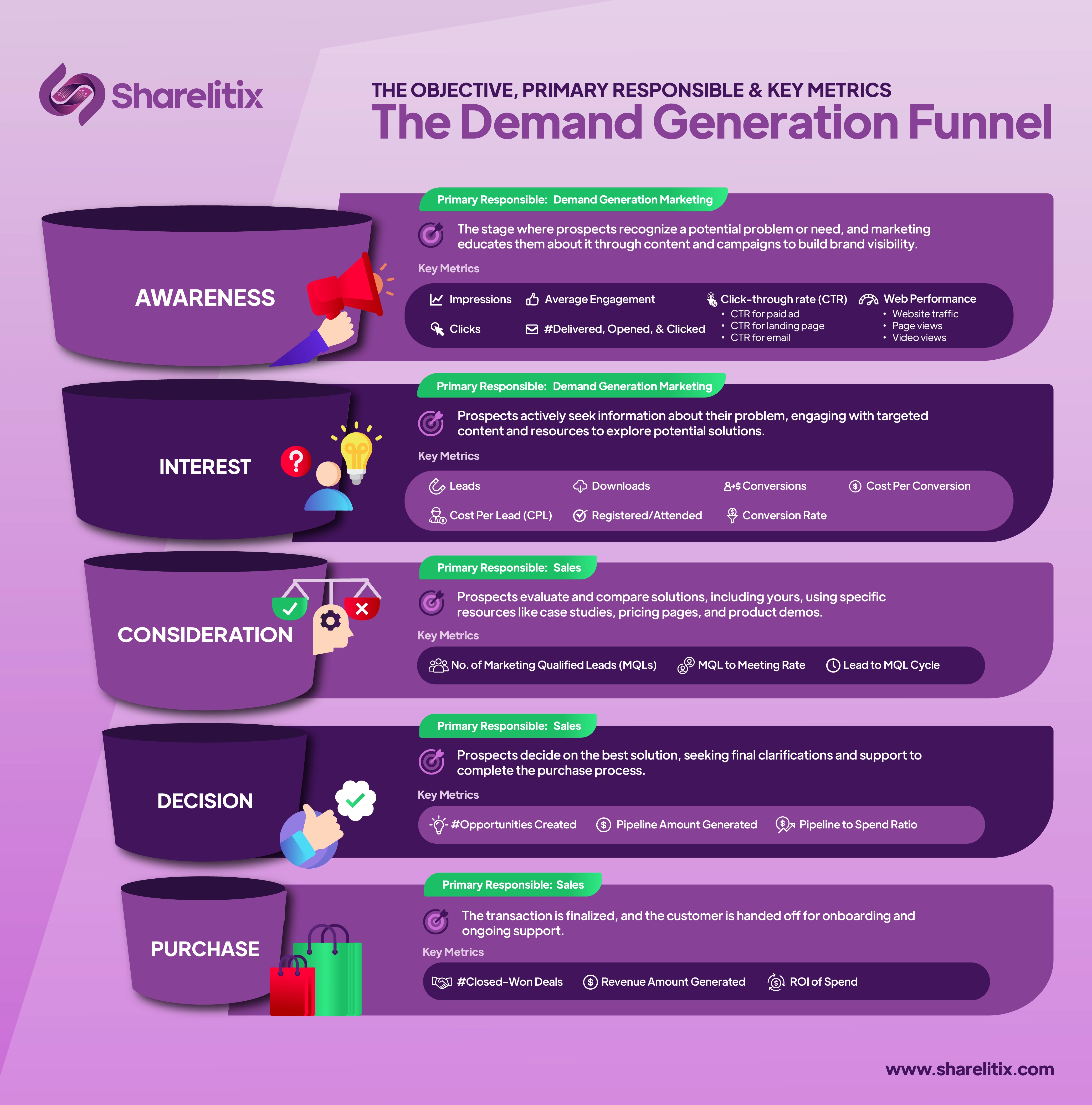
At the top of the funnel, the goal is to build awareness. Prospects may not even know they have a problem yet, and it’s Marketing’s role to educate and inform.
The prospective buyers at this stage start gathering information by surfing the internet, asking colleagues, or browsing social media. This search might land them on unknown territories and "websites" they have never visited before. They might accidentally stumble upon a blog that 'flips the switch,' offering potential solutions to the problem.
Marketing takes the lead by using content marketing, SEO, social media, and paid ads to position your brand in front of a relevant audience. Activities at this stage include attracting prospects to your website through educational blog posts, social media posts, and paid campaigns. The goal is to introduce prospects to your solutions and position your brand as an industry thought leader.
At this stage, Sales plays a minimal role, supporting marketing by providing input on audience pain points that can guide content creation.
In the interest stage, potential buyers are aware of their problem and begin researching potential solutions, often visiting your website multiple times or interacting with other informational content. They may subscribe to your newsletter, download a whitepaper, or register for a webinar to learn more.
Marketing uses targeted content, such as blog posts, eBooks, and webinars, to capture interest. Retargeting campaigns and personalized email nurtures also help move prospects along the funnel. The goal is to make sure the brand is present as they dig deeper, offering value and maintaining interest.
Sales continue to play a secondary role at this stage but may begin interacting with leads that show promising signals of interest. The aim is to provide additional information, answer questions, and ensure prospects are supported during their research phase.
During the consideration stage (also known as the “Marketing Qualified” stage), prospects are actively evaluating their options, including yours. They may visit specific product pages on your website to compare your product to competitors, look at pricing pages, or read case studies to understand how you solve their specific issues. The goal is to show why your solution is superior and keep the prospect engaged.
Marketing takes a secondary, supportive role when prospects reach this stage, providing Sales with deeper content like case studies, product demos, and comparison guides.
Sales formally take the lead at this stage to nurture the lead further, offering consultations and personalized product demonstrations. They help prospects understand how your solution meets their specific needs and answer lingering questions.
In the decision stage, the prospect has learned enough to make a purchase decision and is making moves to understand and complete your sales process. They may reach out directly requesting a product demo or proposal, or connect for final product-specific inquiries.
Marketing plays an even more minimal role at this point. Their goal is to continue supporting sales as needed and ensure that prospects have all the information they need to make a confident decision.
Sales continue leading the charge at this stage, addressing any final objections prospects may have, negotiating terms, and ultimately closing the deal before passing them to the Customer Success team most often. It’s crucial that Sales maintains close contact, providing reassurance and answering any lingering questions at this.
Imagine building a skyscraper. Without strong pillars, the whole thing would crumble. Demand generation works the same way—without its key pillars in place, your marketing strategy won’t withstand the challenges of driving sustained growth.
Below, we explore the critical pillars of a successful demand generation strategy that ensures your growth reaches new heights.
No skyscraper remains standing without a solid foundation. In demand generation, that foundation comes from identifying and understanding your target audience or Ideal Customer Profile (ICP). This translates into gathering primary & secondary research data on your target audience’s demographics (age, location, job title), needs (goals, challenges, motivations), firmographics (company size, revenue, industry/vertical), and behaviors (research activities & sources, intent signals, purchase history) to define your ICP and fuel your demand generation strategy.
Defining your overall ICP is only just the beginning though, the next crucial step is segmentation. Why segment your ICP? Imagine trying to sell a high-performance sports car to someone who only needs and has the budget for a reliable family vehicle, what would your odds of success be? Today’s businesses must segment their ICP into distinct groups with shared characteristics such as industry, to ensure each segment gets the tailored positioning and messaging it requires.
Further refining your well-researched ICP segments into buyer personas that represent the main decision-makers and influencers—the buying committee members— within each segment guarantees precise, resonant messaging for each segment. On the other hand, be aware that if your personas—and by extension, your ICP—are off, your demand generation strategy will end up like a skyscraper built on sand: it will sink.
Another crucial demand generation pillar is mapping out your buyer’s journey. Mapping your buyer's journey involves understanding each step a prospect takes—Awareness, Interest, Consideration, and Decision. Understanding your buyer’s journey per segmented persona is critical in identifying, prioritizing, and launching the right activities at the right time.
Each stage typically comes with its own unique set of activities and objectives, your job is to identify and map them to each stage. Mapping these touchpoints ensures that your content and demand generation campaigns align with their journey, making the path to becoming a customer seamless.
Once the buyer’s journey is mapped, the next objective is to establish an automated system to measure each stage with clear criteria for entry and exit. Lead scoring and grading play key roles in this process. Lead scoring assigns points based on prospect behaviors, while lead grading assesses how well a prospect fits your Ideal Customer Profile (ICP). Together, these tools help identify & prioritize high-quality leads, increase Marketing and Sales alignment, and ensure your demand generation strategy is aligned to your ICP’s needs at each stage of their buying journey.
Setting the right budget and defining clear Key Performance Indicators (KPIs) is crucial for ensuring that each part of your demand generation strategy is properly funded, measurable, and aligned with business objectives.
The best budgets are built on a comprehensive understanding of the full buyer's journey, beginning with overarching revenue objectives and drilling down to granular metrics like cost per lead. A well-planned budget accounts for each stage of the journey, ensuring that marketing efforts are aligned with the broader goals of the organization.
However, Proxima’s research reveals that many companies are missing the mark, wasting 40% to 60% of their digital marketing budgets due to ineffective ad placements and non-human traffic. This underscores a critical gap: businesses often invest heavily in digital ads without ensuring their campaigns reach real, relevant audiences.
To address this issue, budget allocation should be data-driven, relying on historical performance or industry benchmarks to guide investments across marketing channels. By doing so, you can establish the right KPIs that not only track performance but also ensure that every dollar spent is optimized for maximum impact. This approach ensures that both high-level and granular objectives are effectively supported, ultimately contributing to more predictable and sustainable growth.
KPIs serve as checkpoints. Are your campaigns generating enough leads to hit your revenue objectives? Are your lead conversion rates hitting the mark? By measuring performance against well-thought out KPIs, you can track progress and allocate budget effectively to maximize campaign impact and optimize business objectives.
Starting with revenue-based metrics such as revenue generated from campaigns, customer acquisition cost (CAC), and return on marketing investment (ROMI) ensures your marketing activities align with overall business goals.
Next, pipeline metrics—like pipeline value and pipeline-to-spend ratio—give you insight into how well prospects are progressing through the funnel. Conversion rates are also crucial at each stage, indicating the effectiveness of your strategy in turning leads into opportunities and customers.
Finally, focus on lead quality and engagement metrics to refine targeting and optimize content effectiveness. Avoid focusing solely on vanity metrics; tracking the wrong KPIs in isolation can lead to misleading insights and derail your demand generation strategy. Your KPIs should cover the entire buying journey, ensuring you can quickly identify and address any challenges that arise.
Below are more of the key metrics you should track per buyer journey stage: [INSERT TABLE]
They say "content is king," but in demand generation, it’s more like the entire royal family. In fact, research shows that companies that prioritize content marketing see 3 times as many leads while incurring 62% less costs as those who don’t. A well-rounded content strategy is the engine that drives awareness, nurtures interest, and persuades prospects that you’re the best choice. Whether it’s blog articles, infographics, webinars, or podcasts, you need the right type of content to serve different needs across each stage of the buying journey from creating interest to generating leads and nurturing them.
To be truly effective, your content strategy should also incorporate both gated and ungated content assets. Gated content, such as eBooks and whitepapers behind a lead capture form, helps collect valuable contact information for nurturing qualified leads and opportunities. On the other hand, ungated content, like blog posts and infographics, builds trust and authority by offering value upfront, without barriers. A balanced mix of gated and ungated content allows you to nurture prospects effectively while also widening your reach and building brand authority.
Keep in mind that SEO plays a crucial role in the success of your content marketing strategy. Ensuring that your content is discoverable by prospects actively searching for information is what turns your educational materials into powerful lead generators. Demand generation marketing thrives on consistent, valuable content that educates, engages, and is easily found by your target audience. Below is a list of content formats you should consider offering as part your SEO-driven content strategy:
Imagine you're in 'The Matrix,' but instead of Neo dodging bullets, you're trying to connect with your audience. If Neo only focused on dodging bullets in one direction, he'd miss the ones coming from everywhere else. The same is true for demand generation—a single-channel approach leaves too many blind spots.
Companies connecting with customers across three or more channels see an average engagement rate of 250% higher than those relying on just one. Moreover, brands delivering consistent, well-coordinated multichannel experience achieve retention rates up to 91% higher than single-channel approaches, underscoring the power of a diversified strategy.
A full-funnel, multi-channel strategy makes sure you're everywhere your audience might be, just like Neo being aware of every threat. By promoting your brand on multiple platforms—paid ads, SEO, email marketing, and more—you maximize your chances of connecting with prospects wherever they are. Below is a broad list of demand generation channels you can plug into your strategy based on your ICP’s preferences:
mplementing a robust demand generation strategy necessitates a well-rounded and integrated marketing technology (MarTech) stack. The MarTech stack should support all facets of demand generation—from campaign planning and execution to tracking KPIs, reporting on them effectively, and optimizing performance across multiple channels. The right tools enhance efficiency, provide actionable insights, and help align teams. Below is an overview of the key MarTech stack categories crucial for demand generation, with examples:
Selecting and integrating the right tools within each category is crucial for executing a successful demand generation strategy. Ensure that these tools can seamlessly share data and insights to provide a cohesive view of your marketing efforts, enabling informed decision-making and optimized performance.
Account-Based Marketing (ABM) is like hosting a wedding. Instead of inviting everyone under the sun whose name you happen to know, you carefully curate the guest list to ensure only those most important to you are included. Similarly, ABM is a targeted demand generation strategy where marketing and sales collaborate to focus efforts on key high-value accounts, delivering personalized campaigns, messaging, and content that resonate with their specific needs.
When done right, it can profoundly impact your demand generation efforts, significantly boosting engagement with high-value accounts and generating big wins by ensuring your brand delivers precisely the right content, to the right buying committee members, at the right time. In fact, 87% of companies report that ABM delivers higher ROI than other marketing methods, thanks to its enhanced visibility and flexibility, which allow for better resource allocation and focused spending on priority accounts.
However, ABM isn't suitable for every business. It requires assessing factors like bandwidth, marketing and sales alignment, and available resources to determine if your organization can execute ABM effectively. Success with ABM relies on a holistic strategy with alignment between marketing, sales, and leadership, ensuring shared goals and coordinated actions. ABM works best when these teams are in sync, using data-driven insights to deliver personalized value, deepen engagement, and ultimately build trust with targeted accounts.
To help you better understand demand generation and its role in B2B marketing, we've compiled a list of frequently asked questions. These questions further address common concerns and misconceptions that marketers and business leaders have while researching demand generation strategies.
While demand generation and lead generation are closely related and overlap in certain stages of the buyer’s journey, they serve different purposes in a marketing strategy.
Demand generation focuses on creating awareness and interest for your product or service in the broader market, both currently in-market and not. It aims to educate potential customers and keep your brand top-of-mind, even for those not yet ready to buy.
Lead generation, on the other hand, involves capturing information from prospects who have shown interest and turning that interest into actionable leads for sales.
In other words, demand generation focuses on building both brand awareness and high-quality leads, and lead generation focuses on capturing specifically prospects who have shown signals of interest.
Demand generation is a broad approach that targets a wide audience, often across multiple industries, usually aiming to create interest across the entire Total Addressable Market (TAM). In contrast, Account-Based Marketing (ABM) is a more laser-focused strategy targeting fewer, high-value accounts with personalized tactics. ABM can be seen as an element within the broader demand generation strategy, serving as a targeted method to generate demand among key accounts. Both strategies are complementary, with ABM typically applied to key accounts while demand generation builds awareness and interest across a wider audience.
Growth marketing and demand generation share some similarities but have distinct focuses. Growth marketing is about driving overall business growth through various marketing tactics, which includes customer retention, upselling, and cross-selling. Demand generation, on the other hand, is primarily focused on creating awareness and generating interest among new prospects. Growth marketing includes demand generation as a component, but it goes further to ensure overall customer lifecycle optimization and long-term growth.
Demand generation is a long-term investment that requires consistency and patience. Unlike direct response marketing, where results can often be measured immediately, demand generation takes time to build awareness, nurture relationships, and create trust with prospects. Depending on your industry, audience, and tactics, it may take several months to see significant results. The key is to remain consistent and focus on both short-term KPIs (like engagement rates) and long-term goals (like pipeline growth).
Paid and organic channels work together to create a holistic demand generation strategy. Organic channels like SEO, content marketing, and social media help build awareness and credibility over time. Paid channels like PPC, social ads, and programmatic advertising can provide a quick boost to your efforts by reaching targeted audiences more directly. Combining both ensures you’re engaging prospects throughout their journey and maximizing visibility across different touchpoints.
Trying to build or execute a full-funnel, multi-channel demand generation strategy? Sharelitix is here to help.
As a strategy-first B2B Demand Generation Agency, we specialize in solving both strategic and tactical challenges. Whether you need expert guidance to craft a winning strategy or a skilled team to lighten the load and execute with precision, we’ve got you covered.
Our tailored approach ensures you get exactly what you need—no more, no less. From high-level strategy to hands-on execution, Sharelitix fills the gaps so you can focus on driving growth and achieving your goals.
Let’s turn your challenges into opportunities for growth.





.svg)